
How to Create a RESTful API with FastAPI in Python
Hello, budding developer! Today, we’re diving into the world of building a RESTful API using FastAPI, a modern web framework for Python that allows you to build APIs quickly and easily. If you’re just starting out or looking to simplify your current development process, FastAPI is a fantastic choice. So let’s roll up our sleeves and get started!
What is FastAPI?
FastAPI is a relatively new web framework that boasts lightning-fast performance, automatic interactive API documentation, and a developer-friendly interface. Thanks to its design, FastAPI enables you to write simple, succinct code while taking advantage of Python’s type hints.
Setting Up Your Environment
Before writing any code, let’s make sure you’ve got everything you need installed.
1. Python: FastAPI requires Python 3.7 or higher. Check your version by running:
bash
   python --version
If you don’t have the required version, download it from python.org.
2. Virtual Environment (Optional, but recommended): It’s always a good idea to use a virtual environment for your projects to keep dependencies organized. Set it up with:
bash
   python -m venv env
   source env/bin/activate  # On Windows, use: .\env\Scripts\activate
3. Install FastAPI and Uvicorn: FastAPI needs a server, and Uvicorn is the go-to for deploying FastAPI applications.
bash
   pip install fastapi uvicorn
Awesome! With everything ready, let’s build your first FastAPI application.
Creating Your First FastAPI App
1. Project Structure: Create a new directory for your project:
   fastapi-example/
   └── main.py
2. Basic Example: Open main.py and enter the following code:
python
   from fastapi import FastAPI

   app = FastAPI()

   @app.get("/")
   async def read_root():
       return {"Hello": "World"}
Let’s break down what’s happening:
– FastAPI() initializes a new FastAPI application.
– @app.get("/") is a decorator which defines a route at the root path /. When someone opens your API’s base URL, this function will execute.
– async def read_root() is an asynchronous function that returns a simple JSON object.
3. Running Your Application: Use Uvicorn to serve your application.
bash
   uvicorn main:app --reload
Open http://127.0.0.1:8000 in your web browser, and you should see:
json
   {"Hello": "World"}
Adding More Functionality
Let’s add more routes to make your API more exciting.
Creating Dynamic Routes
Modify main.py to include a dynamic route example:
python
@app.get("/items/{item_id}")
async def read_item(item_id: int, q: str = None):
    return {"item_id": item_id, "q": q}
– Here, {item_id} is a path parameter. The function can receive this parameter as an argument and use it within.
– The query parameter q is optional. You can append it to the URL like so: /items/42?q=query.
Adding POST Method
Let’s add a simple POST route to accept data:
python
from pydantic import BaseModel

class Item(BaseModel):
    name: str
    description: str = None
    price: float
    tax: float = None

@app.post("/items/")
async def create_item(item: Item):
    return item
– Pydantic is used here for data validation. Item class extends BaseModel, defining expected data inputs.
– When you send a POST request to /items/ with JSON data matching this model, FastAPI will handle validation.
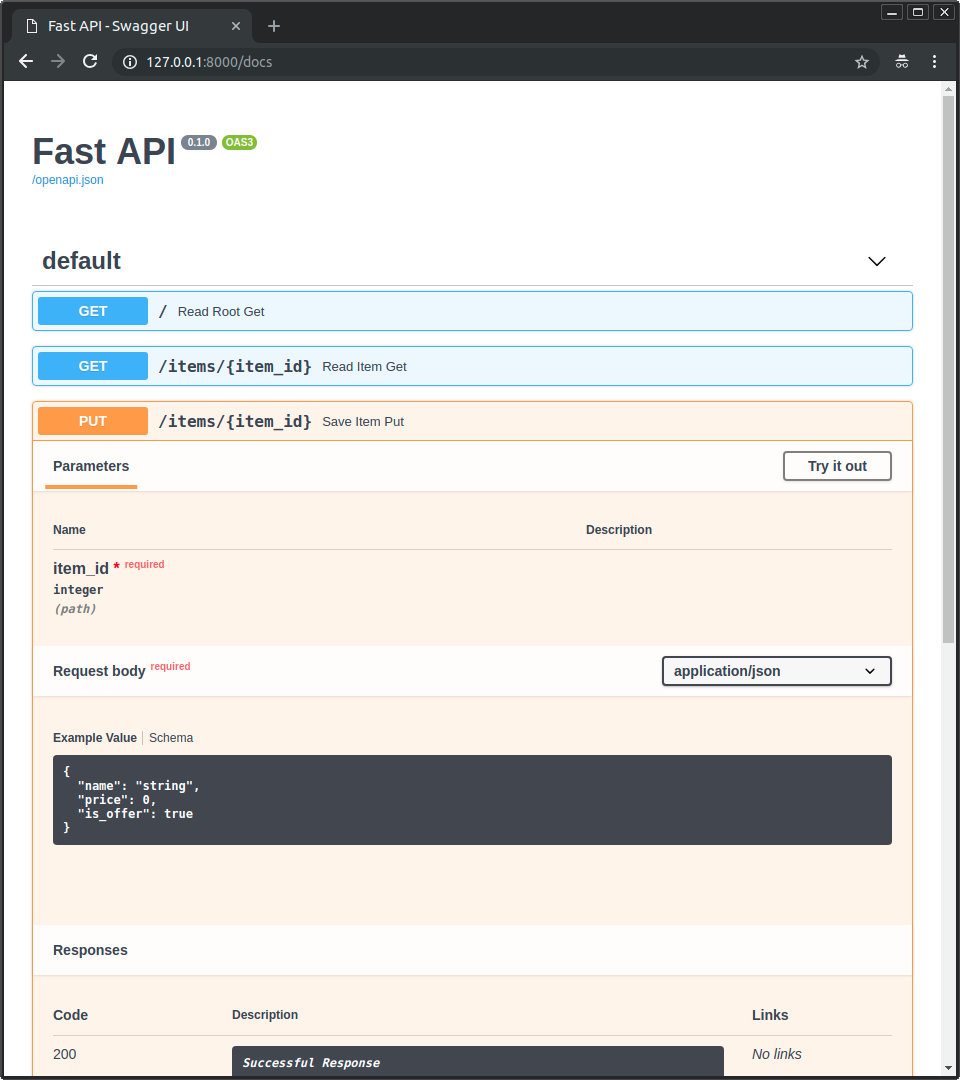
Exploring Documentation
One of FastAPI’s star features is automatic documentation. Visit:
– API Docs: http://127.0.0.1:8000/docs to see Swagger UI in action.
– Redoc: http://127.0.0.1:8000/redoc for another documentation style.
Handling Errors and Responses
FastAPI makes error handling straightforward. By default, FastAPI will return an appropriate error response if required parameters are missing or incorrect types are provided.
Here’s how you can customize error responses:
python
from fastapi import HTTPException

@app.get("/files/{file_id}")
async def read_file(file_id: str):
    if file_id not in ["file1", "file2"]:
        raise HTTPException(status_code=404, detail="File not found")
    return {"file_id": file_id}
– By raising HTTPException, you control the HTTP status code and message returned.
Conclusion and Practice Ideas
Congratulations! You’ve just built a RESTful API with FastAPI. Your small app can grow into a powerful system by extending more endpoints and integrating databases.
Next Steps:
– Implement authentication using OAuth2 or JWT.
– Connect to a database using SQLAlchemy or Tortoise ORM.
– Explore middleware to handle CORS, logging, and more.
I hope this tutorial energizes your API development journey. FastAPI’s community and documentation are friendly resources if you ever get stuck. Happy coding!
If you have questions or run into hurdles, feel free to drop a comment or shoot me an email. I’d love to help. Until then, keep building amazing things!